Free Cash Flow to Equity (FCFE) Explained: A Complete Guide
Educational content only. This analysis is for informational purposes and does not constitute financial advice or a recommendation to buy or sell any security. Data sourced from SEC EDGAR filings and company earnings releases. Verify figures independently before making investment decisions.
Free Cash Flow to Equity (FCFE) Explained
When analysts talk about "free cash flow," they're usually referring to the unlevered version: cash generated by the business before accounting for debt. That's a useful starting point for valuing the whole firm. But equity investors own a claim that sits below the debt holders. After interest payments go out and net borrowings come in, what remains is free cash flow to equity (FCFE), the cash actually available to common shareholders. Understanding the difference between these two measures, and knowing when each one is the right tool, is fundamental to equity valuation work.
What FCFE Measures
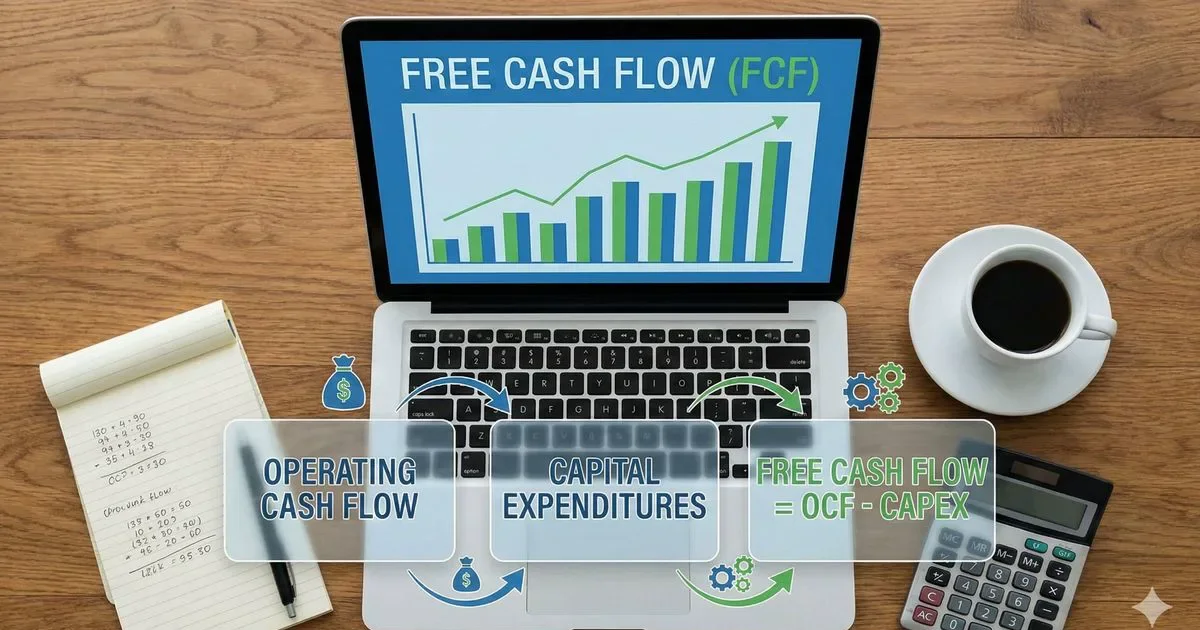
FCFE, also called levered free cash flow (LFCF), represents the cash that could theoretically be distributed to equity holders without impairing the business. It accounts for every cash obligation that comes before equity: operating expenses, capital expenditures, changes in working capital, and, critically, net debt activity.
The simplest way to calculate it starts from the cash flow statement:
FCFE = Operating Cash Flow − Capital Expenditures + Net Borrowing
Or derived from unlevered free cash flow (FCFF):
FCFE = FCFF − Interest Expenses × (1 − Tax Rate) + Net Borrowing
The after-tax interest adjustment removes the cash that belongs to debt holders. Net borrowing adds back any new debt raised (which is available to equity) and subtracts debt repaid (which is a cash outflow). What remains is the equity slice.
This levered framing connects directly to shareholder-facing decisions. If FCFE is positive and growing, the company has real capacity to pay dividends, repurchase shares, or build cash reserves (see how FCF applies to dividend safety analysis). If FCFE is weak or negative despite strong FCFF, debt service is consuming the equity cushion, which is a meaningful risk signal. For a deeper look at what makes any FCF figure trustworthy, see assessing FCF quality.
FCFE vs. FCFF: Which to Use
The choice between FCFE and FCFF shapes the entire structure of a DCF valuation:
The FCFF approach is more common in practice, and for good reason. Forecasting future debt levels and borrowings introduces another layer of assumptions, and errors in those assumptions flow directly into the equity value. FCFF sidesteps that complexity by treating the capital structure as a discount rate problem rather than a cash flow problem. That's one reason most investment bank DCF models default to FCFF plus a WACC.
FCFE becomes the natural choice when the capital structure is a key part of the story. Leveraged buyout analysis, for instance, explicitly models debt paydown as value creation, and you need FCFE to capture that. Financial institutions (banks, insurers) are also typically valued on an FCFE basis because their debt is part of the operating model, not the financing structure, and separating the two cleanly is difficult. For most operating companies, though, FCFF will give you the same answer with fewer inputs to estimate.
FCFE in a DCF Model
When building an equity DCF using FCFE, the mechanics are straightforward: project FCFE over a forecast period, discount each year's cash flow at the cost of equity (not WACC), and add a terminal value also discounted at the cost of equity. The sum is the equity value directly; no need to subtract net debt, because debt has already been accounted for in the cash flows themselves.
The cost of equity is typically estimated using the Capital Asset Pricing Model (CAPM): risk-free rate plus beta times the equity risk premium. That discount rate is higher than WACC for most companies, which makes sense: equity holders take on more risk than debt holders and require a higher return to compensate.
One practical implication: FCFE can be negative in years when debt repayment or capex exceeds operating cash flow, even for healthy businesses. Negative FCFE doesn't mean the equity is worthless; it means the company is consuming cash in that period. Project through the full cycle before drawing conclusions from any single year's figure. See also how owner earnings and normalized capex address similar cycle-averaging problems in Buffett's framework.
FCFE and FCFF answer slightly different questions. FCFF asks how much cash the business generates regardless of how it's financed. FCFE asks how much of that cash actually reaches equity holders after the debt stack takes its cut. Both are valid; the right choice depends on what you're trying to value and how the business is structured. For most straightforward equity analysis, and for thinking about FCF yield as a valuation metric, the unlevered approach is simpler and usually sufficient. FCFE earns its added complexity in specific situations: highly leveraged structures, financial institutions, or any case where the debt repayment profile is itself a significant source of equity value creation.
Data Sources & References
Financial data referenced in this article is drawn from primary sources:
- SEC EDGAR: company 10-K, 10-Q, and 8-K filings
- Investor letters from Berkshire Hathaway, Fundsmith, and other publicly available sources
- Academic research and central bank publications where cited inline
Investments involve risk. Past performance is not indicative of future results. This content is for educational purposes only and is not investment advice.